
Search Haywood County Divorce Records
Haywood County Divorce Records can start in the circuit court clerk office in Brownsville, but old files often need help from the state archive side. That makes Haywood County a good county for careful searches. The active courthouse file gives you the decree and current court papers. The historical path can lead to a docket, an index, or a microfilmed file from an earlier time. If you know the spouse names and the date range, the search gets much easier. If you only know the county, the clerk and the archive trail can still help you narrow the file.
Haywood County Quick Facts
Where Haywood County Divorce Records Start
The Haywood County Circuit Court handles divorce proceedings and keeps the court file for cases filed in the county. The circuit court clerk in Brownsville is the first office to check when you want the decree, the complaint, or a certified copy. That is the active route. The county clerk office is still worth checking for marriage licenses and other county business, but it is not the home of the divorce decree itself. In Haywood County, the court clerk remains the key office for the record you usually need.
Haywood County has a strong archive trail too. The research notes show divorce court docket material from 1941 to 1965, divorce files from 1860 to 1936, divorce index entries from 1860 to 1936, and other files from 1808 to 1885. That is a lot of history for one county. It means Haywood County Divorce Records can be searched in both current and historical layers. If the divorce is recent, the courthouse is the right stop. If the divorce is old, the archive record may be the faster path.
For the court file, use the Haywood County Circuit Court.
That office is the main source for a fresh Haywood County Divorce Records request.
For the county office context, use the Haywood County Clerk page.
It is useful for marriage records and nearby county questions.
Search Haywood County Divorce Records
Haywood County searches go best when you bring the spouse names and a filing year. A case number is even better. The circuit court clerk can search by those details and tell you whether the file is at the active desk or in storage. That matters in a county with a long court history because a request that is too broad can slow things down. A narrow date range is often the fastest way to find the right file.
Haywood County Divorce Records also connect to the statewide certificate system. Tennessee Code Annotated section 68-3-402 tells court clerks to forward divorce records to the Office of Vital Records each month. That means a county file and a state certificate can both exist for the same divorce, but they serve different needs. The county file is the full packet. The state certificate is the shorter proof. If you need the terms of the case, ask the court clerk. If you only need proof that the divorce happened, the state office can work.
- Full name of one spouse
- Approximate filing year
- County of filing
- Case number, if known
- Copy type you need
For the certificate route, Tennessee Vital Records explains how to order in person, by mail, or online. That is the cleanest way to get a short proof-of-divorce document. The county clerk is still the place to go if you need the full decree or the case file with all the terms.
Use Tennessee Vital Records help for the state ordering steps.
It is the fastest official route for a certificate copy.
Haywood County Divorce Records and Access
Haywood County Divorce Records are public records, but the court still protects private details. Tennessee's public records law gives access, yet divorce files can still have redactions or sealed parts. That is common. A record can be public and still not show everything. In Haywood County, the clerk will usually give you the copy that fits the rule set, but sensitive details may be blanked out if the law requires it. That does not mean the record is closed. It means the law is doing its job.
For the law side, section 68-3-402 explains why Haywood County divorce records also exist at the state level. The county and state systems work together. That helps if you are looking for a certificate or trying to confirm a filing year. It also helps if a court file is old and you need a second path. The same divorce can show up in more than one record system, and that is normal in Tennessee.
Note: A county decree gives the terms, but a state certificate only confirms the event.
For a statewide archive map, use the Tennessee State Library and Archives guide.
It is useful when Haywood County Divorce Records move from the courthouse into archive care.
Historical Haywood County Divorce Records
Historical Haywood County Divorce Records are unusually rich. The research notes point to divorce court docket records from 1941 to 1965, divorce files and indexes from 1860 to 1936, and other files from 1808 to 1885. That kind of spread means Haywood County is a strong place for older family history work. The Tennessee State Library and Archives also keeps microfilm copies and historical court material, which gives a second route when the courthouse file is too old or too deep in storage.
Those old records can be helpful for more than one reason. They can confirm a marriage break, show the year a decree was entered, or place a family name in the right county at the right time. If you are working on genealogy, that can be the difference between a guess and a clear match. Haywood County Divorce Records are easier to place once you know which date range the case belongs in, and the archive notes give you that range up front.
Here is the local historical source tied to the manifest image.
The image source is Haywood County Vital Records on Archives.com.
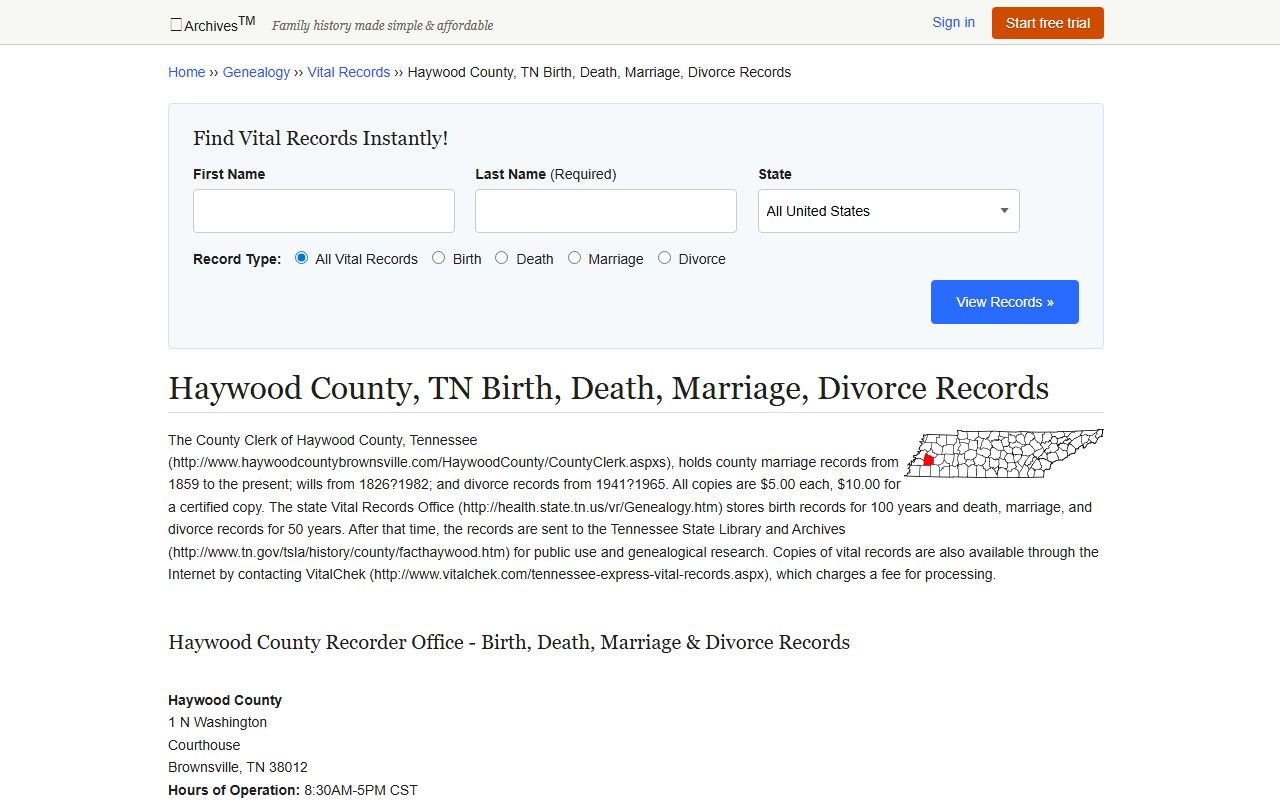
That image fits the historical path because it points to the old Haywood County divorce record ranges.
Order Haywood County Divorce Records
To order Haywood County Divorce Records, decide whether the county decree or the state certificate is the paper you need. The county circuit court clerk is the right office for a certified decree or a full case file. The state Office of Vital Records is the right office for a shorter certificate. That choice matters because the wrong paper can slow down a name change, a property issue, or a benefit request. The faster path is the one that fits the use.
Haywood County searchers who need the state certificate can use the Tennessee Vital Records help center or the official VitalChek order path. If the record is old, the clerk may need time to locate it. That is normal. The historical paper trail is broad, but it still takes a clear request to move it fast.
Use the CDC Tennessee vital records page for the state fee and office summary.
It gives a quick check on the certificate route.
Help With Haywood County Divorce Records
The Tennessee Court System is the main help site if you need forms or filing guidance tied to a divorce case. That is useful if you are doing more than a record search and need to understand the court paper trail. Haywood County Divorce Records make more sense once you know which part is the decree, which part is the certificate, and which part is only a docket or index entry. The court forms and instructions help connect those pieces.
The county clerk office can also help frame related records. Marriage records, county admin items, and old court references all make the divorce search clearer when you need the full story. Haywood County Divorce Records work best when the search stays narrow and the related records are used only when they help. That keeps the request sharp and the result easier to read.
Use tncourts.gov for general court forms and divorce guidance.
It is the best statewide support point for a Haywood County divorce search.
Related Haywood County Records
Haywood County Divorce Records often connect to marriage licenses, land records, and probate files. A marriage license proves the start of the marriage. A land record can show what changed after the divorce. Probate files can help if the family line later moved into estate work. These records do not replace the divorce decree, but they fill in the gap around it. That is especially useful in a county with archive ranges that stretch back into the early 1800s.
If you are tracing a family line, keep both the clerk and the archive trail in view. Haywood County Divorce Records are much easier to follow when the related records are part of the same search plan.