
Find Lawrence County Divorce Records
Lawrence County Divorce Records usually start in Lawrenceburg with the circuit court clerk. The county clerk handles marriage licenses and related county business, but the divorce case file itself stays with the circuit court. That makes the search path pretty direct once you know the county. A good request names the spouses, the filing year, and whether you want a copy or only a lookup. Lawrence County has a long record trail, so older files can also move into the Tennessee archive system. If the divorce is historic, the state library guide and county history can help narrow the year before you order a copy.
Lawrence County Quick Facts
Lawrence County Divorce Records Office
The Lawrence County Circuit Court handles divorce proceedings and keeps the court file that most people need for a decree or certified copy. That office is the first stop for Lawrence County Divorce Records. The county clerk office is still important because it handles marriage licenses and other local record work, but the divorce packet stays with the circuit court clerk. In practical terms, that means the court clerk is the office that can actually pull the file.
Lawrenceburg gives the county a single clear courthouse center, so the search path is not hard once you know the office structure. If you only need to know whether a case exists, the clerk can often narrow the search by name and year. If you need the full decree, the circuit court clerk is the right place to ask for the copy. That split is simple, but it matters. A clean request keeps the search from bouncing between the county clerk and the court clerk.
For the county court source, use the Lawrence County Circuit Court.
For the county clerk source, use the Lawrence County Clerk.
That county clerk image helps show the related office that often sits next to a divorce search, even though the court keeps the file itself.
Note: The county clerk helps with marriage records, but the divorce case file belongs with the circuit court clerk.
Search Lawrence County Divorce Records
Searches move best when the request is narrow. Give the clerk the spouse names, the county, and an approximate filing year. If you know the case number, include it. If you only want a lookup and not a copy, say that clearly. Lawrence County Divorce Records are easier to find when the clerk can move straight to the right file instead of searching a wide date range. That is true in older files too, where a small date window can save a lot of time.
Because the county has a long record trail, older divorces may also show up in archive notes or index work. That is where the Tennessee State Library and Archives guide can help. It shows how older records move out of the active office and into historical custody. If the divorce was long ago, the archive path may give you the year before the courthouse copy request is made. That keeps the final request shorter and more accurate.
- Full names of both spouses
- Approximate filing year
- County where the case was filed
- Case number, if you have it
The county clerk office is the related records source at the Lawrence County Clerk.
That office helps with marriage context and other county records that may support a divorce search.
Lawrence County Divorce Records Fees
Fees vary by office and by the kind of copy you want. Lawrence County court copy fees can change, and certified copies cost more than plain copies. If you only need to know whether a case exists, ask first about a lookup before you order copies. That can keep the request cheap and save time. A certified decree costs more because the clerk adds the certification that makes it useful for legal use.
The state certificate fee is separate from the county copy fee. Tennessee sets the certified divorce certificate price at $15 per copy. That certificate is the shorter record. It proves the divorce happened, but it does not replace the full Lawrence County court file. The best way to keep the fee straight is to decide whether you need proof of the event or the full order before you send the request.
For the filing rule that sends the county record into the state system, see T.C.A. section 68-3-402.
That statute explains why the clerk's report and the state certificate record stay linked.
Note: County copy fees and state certificate fees are different. Make sure the request matches the record you need.
For the local vital records research lead, use the Lawrence County vital records page.
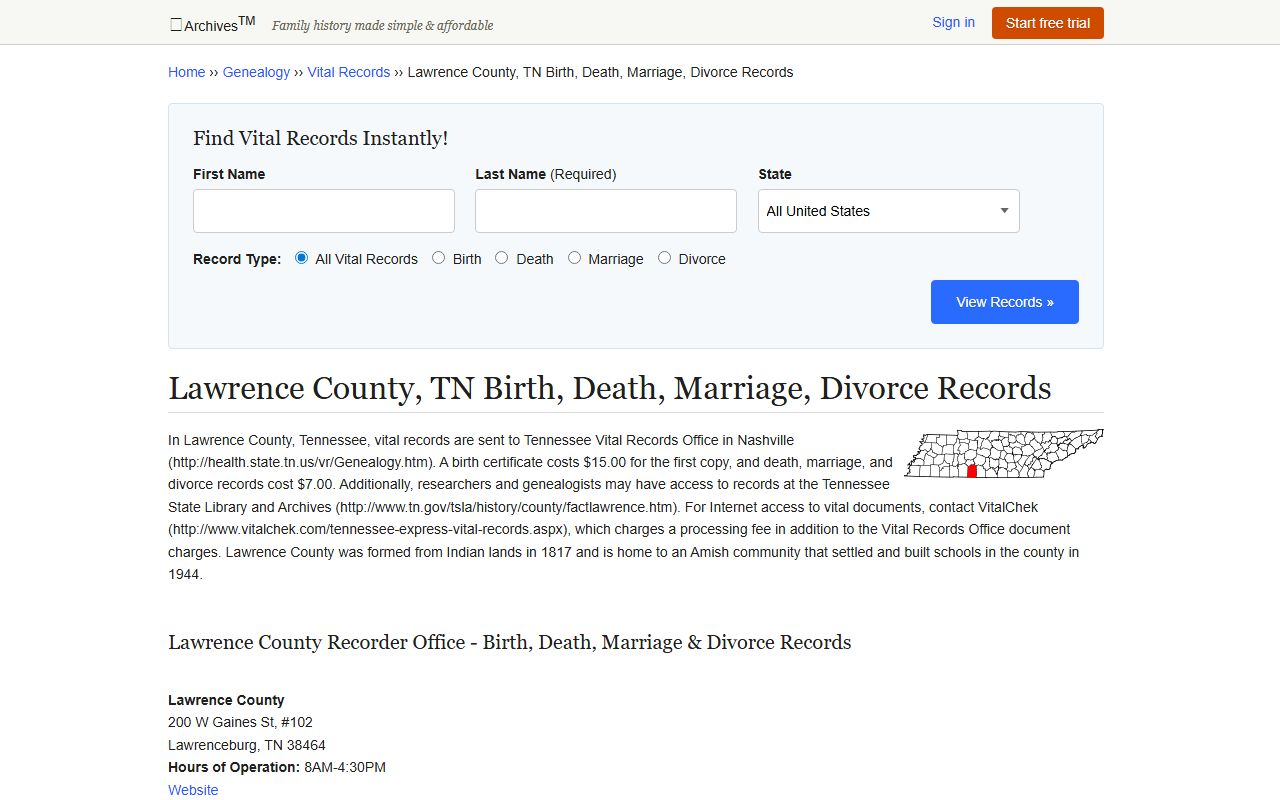
That image comes from the local vital records research lead and helps show the broader county record trail.
Historical Lawrence County Divorce Records
Lawrence County was formed in 1817, and that longer history means older divorce records can become part of the county archive trail. The Tennessee State Library and Archives keeps historical county court records on microfilm, which can help when a divorce is too old for an easy clerk pull. If you are working on family history, the archive trail may be the best way to find the surname or filing year before you ask for a copy. Lawrence County Divorce Records often get easier once the date range is narrowed.
The county's long record history also means the court file may no longer sit in a current stack. It might be in storage or in an archive index instead. That is why historical searches should start with the year as closely as possible. A good date range saves time for both the researcher and the clerk. The archive route is not a replacement for the courthouse, but it is often the fastest way to find the right file for an old Lawrence County divorce.
For the archive guide, use the Tennessee State Library and Archives vital records guide.
That image is useful for the historical trail because older court records often start with an index or archive lead before the clerk copy request.
Order Lawrence County Divorce Records
If you need the full decree, order it from the Lawrence County Circuit Court Clerk. If you only need proof that the divorce happened, the state certificate is the shorter route. The county court file has the detail, while the state certificate gives you a clean proof document. That difference matters when you are filing a legal form, changing a name, or trying to confirm a past divorce without needing the whole packet.
Lawrence County Divorce Records are easier to order when the request is specific. Ask for the decree if that is what you need. Ask for the certificate if a shorter document will do. If you are not sure, tell the clerk what you plan to use the record for and let the office point you to the right version. That can save time and keep you from paying for the wrong copy.
For the county court source, go back to the Lawrence County Circuit Court.
That office is the best start when a Lawrence County request needs the actual divorce decree.
Public Access and Related Records
Lawrence County Divorce Records are generally public, but the court can still protect sensitive details inside a file. That is normal in Tennessee. The public can inspect the record, yet sealed pages and redacted information remain under court control. If a file includes private financial data or other protected material, the copy you receive may not show everything. The record is open, but not unlimited.
Related records help when you are trying to build the whole picture. Marriage licenses, property records, and older court indexes can give context around the divorce. The county clerk handles the marriage side, while the circuit court clerk keeps the divorce file. If you are not sure which office to contact first, begin with the circuit court and then add related county records if the search needs more detail. That is usually the cleanest path for Lawrence County Divorce Records.
For a broader county browse view, use /counties.html.
That index makes it easier to move from Lawrence County Divorce Records to other Tennessee county pages when you need a second search path.