
Search Obion County Divorce Records
Obion County Divorce Records are centered in Union City, but the record you need may sit in a county case file, a state certificate index, or an archive reel from an older court run. Recent searches usually start at the circuit court clerk. Older work often moves toward the Tennessee State Library and Archives, where Obion County indexes and microfilmed court material help trace the name, date, and court path. That split matters because the right office depends on the age of the divorce and the paper you need. If you want a decree, a certificate, or an index note, start with the source that actually holds that version of the record.
Obion County Quick Facts
Where Obion County Divorce Records Start
The Obion County Circuit Court handles divorce proceedings for the county and keeps the case file that most people need first. If you want the complaint, the final decree, or a certified copy of the order, the circuit court clerk is the first stop. That office serves Union City and the rest of the county, so a good search usually begins with a spouse name and a rough filing year. The circuit court page in the Tennessee court system is the cleanest local doorway into Obion County Divorce Records, especially when you already know the case was filed in Obion County.
For older records, the search widens. The Tennessee State Library and Archives notes that Obion County has divorce records from 1930-1950 and divorce and other court indexes from 1823-1950 on microfilm. That means a search may move from the courthouse to the archive shelf if the divorce is older. The local county office is still part of the record map because it handles marriage licenses and county business, but the divorce file itself stays with the circuit court clerk. Knowing that split saves time and keeps the request pointed at the right desk.
Use the local court page at the Obion County Circuit Court to start the search.
The manifest image below comes from Obion County vital records on Archives.com and fits the same search path.
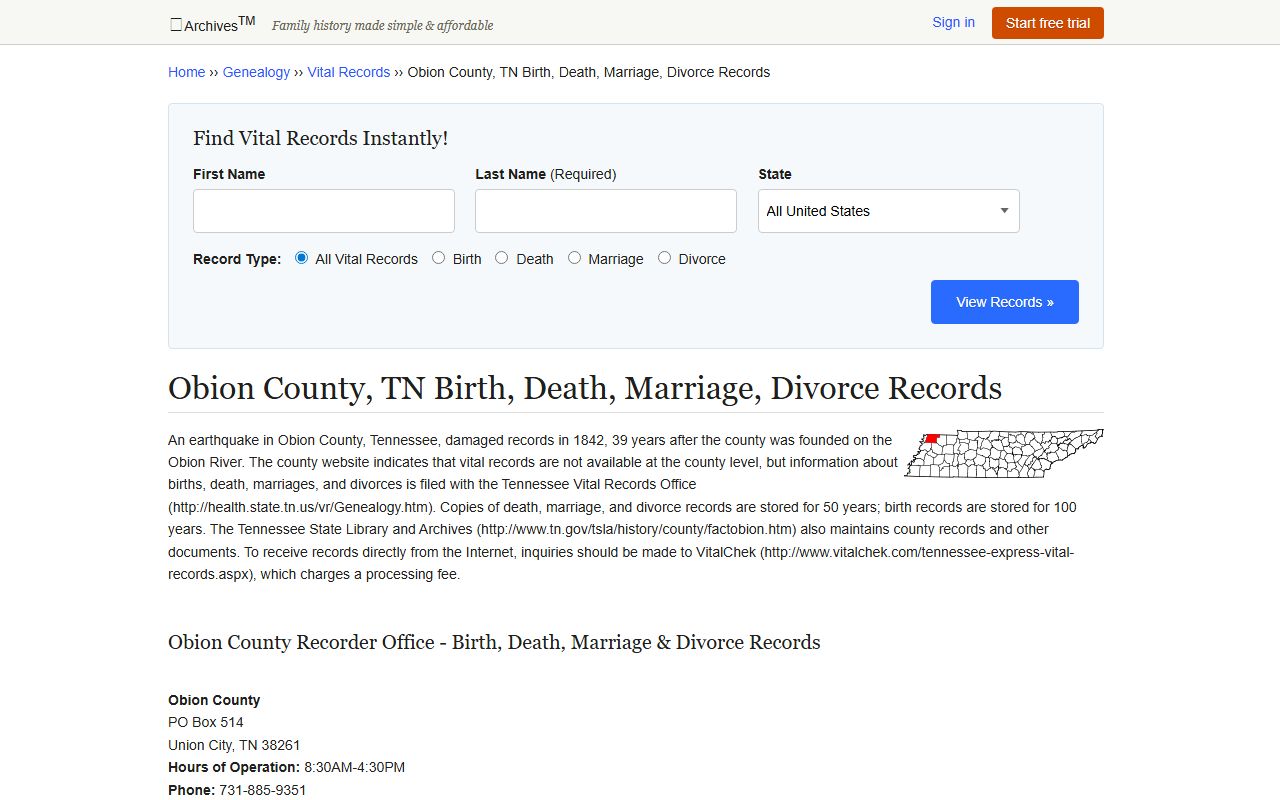
That image points to the kind of older record trail that helps when Obion County Divorce Records are not sitting at the live court counter.
Search Obion County Divorce Records
A solid Obion County Divorce Records request should be short and specific. Full spouse names help the clerk find the case faster. A rough filing year narrows the window. A case number is even better, but it is not required if you do not already have it. The more exact your ask, the faster the clerk can tell you whether the file is in active storage, archive storage, or the state certificate system. That applies to both recent and historical work.
Obion County searches also connect to statewide tools. The Tennessee Office of Vital Records explains how to get a divorce certificate in person, by mail, or online, and the CDC Tennessee vital records page points people to the same state office. That is useful when you only need proof that the divorce happened. If you need the full decree, the county court file is still the better source. The state certificate gives the basic event details. The county decree gives the court order and the terms tied to the divorce.
Use the state help center at Tennessee Vital Records when the county file is not enough.
That route works best for a certificate request, not for a full court packet.
Note: A state certificate confirms the divorce event, but the county decree is usually the better paper for later legal work.
Obion County Divorce Records and Access
Obion County Divorce Records are generally public, but public does not mean unlimited. Court files can still have redactions for private data, and some material may be sealed if a judge finds a reason to protect it. The Tennessee Public Records Act is the broad rule that lets people ask for records, while Tennessee's access exceptions explain why certain pages may stay closed. That is normal for divorce work because the file often carries names, finances, children, and other sensitive details.
The state entitlement guidelines also matter when you want a certificate from the Office of Vital Records. Tennessee says the person named on the record, close family members, legal guardians, and certain representatives may request records if they show the right proof. That does not replace court access, but it does shape the state certificate side of Obion County Divorce Records. If you are asking for a certificate on behalf of someone else, make sure the relationship and ID papers match the state rules before you send the request.
For the access rules summary, see Tennessee Public Records Act exceptions.
That state guide helps explain why some divorce file pages are open while others remain redacted or sealed.
Note: The access rules are the same across the state, but the local clerk still decides what version of the record can be copied.
Historical Obion County Divorce Records
Obion County's older divorce history is one of the reasons the county page matters. The Tennessee State Library and Archives says the county has 1930-1950 divorce records on microfilm, plus divorce and other court indexes that reach back to 1823. That kind of record trail makes historical searches easier because a researcher can often find the surname or filing year before asking for a copy. Obion County was established in 1823, so the archive trail reaches into the county's long court history.
Historical searches also benefit from the broader Tennessee record guide. The Tennessee State Library and Archives says records older than the vital records retention period move to archive custody, and the Library of Congress repeats the same basic rule for older Tennessee vital records. For Obion County, that means a search may start in Union City but finish in a state archive room. That is normal. The county court file and the archive index are parts of the same trail, just in different places.
Use the Tennessee State Library and Archives vital records guide when the divorce is old enough to leave the courthouse desk.
That guide is the best map for older Obion County Divorce Records that have moved beyond current court storage.
Order Obion County Divorce Records
If you need a divorce certificate instead of the full court file, Tennessee Vital Records is the state office to contact. The office in Nashville accepts requests in person, by mail, and online through VitalChek. It also requires identification for most requests. That makes it a good fit when you only need the short state record and do not want to pull the county court packet. Obion County Divorce Records can therefore split into two tracks: the county decree path and the state certificate path.
The state law behind that split is Tennessee Code Annotated section 68-3-402. The statute requires the court clerk to file divorce records with the Office of Vital Records, which is why the state certificate system exists at all. It helps explain why a search in Obion County may also turn into a state request. A divorce can appear in the county file first and then in the state record system later. That is useful if you are trying to order the right paper without making two separate trips.
For the filing rule, read T.C.A. § 68-3-402.
The statute shows how county court records move into the state vital records system.
Use VitalChek for Tennessee when you want the online certificate route.
That option is useful for a fast certificate request, but it does not replace the county decree file.
Note: If the court record is old, the archive may be the faster route than a fresh courthouse search.
Help With Obion County Divorce Records
Obion County Divorce Records searches often get easier once you know whether you are chasing a court file, a state certificate, or a historical index. The Tennessee Secretary of State FAQ points people back to the state library and archives guide when the record is old. The state guide and the archives.com county summary both show the same pattern: the live courthouse file is best for newer records, while older records often need archive help. That is why a good search starts with the court and ends with the right backup source.
The Library of Congress also gives Tennessee researchers a simple rule of thumb. If the divorce is recent, use the Office of Vital Records. If the divorce is older, use the State Library and Archives. That rule is practical in Obion County because it keeps the request moving in the right direction. It also avoids the most common mistake, which is asking the wrong office for the wrong document. When you match the record type to the office, the search gets much shorter.
Use the Tennessee Secretary of State divorce records FAQ for a short archive map.
That FAQ is a quick way to confirm whether your Obion County Divorce Records search belongs in the state archives or the vital records office.
The county seat, the archive index, and the state certificate trail all point to the same basic fact: record type matters. A court decree, a certificate, and an index entry all tell a different part of the same divorce story.
Related Obion County Records
Obion County Divorce Records often connect to marriage records, property transfers, and older court indexes. A marriage record can confirm the first date in the timeline. A property record can show what changed after the divorce. A court index can help locate a file when the decree itself is still buried in storage. That kind of record chain matters in a county with a long court history and older microfilm holdings. It gives you a way to track the divorce from more than one angle.
That is also why searchers should not stop with the first result. If the county court only has an index, use that to narrow the year. If the state has the certificate, use that to confirm the event. Then go back to the county for the decree if you need the terms. The trail is usually short once the office and record type are matched. In Obion County, the local court, the state office, and the archives all have a role in that process.