
Find Perry County Divorce Records
Perry County Divorce Records are tied to Linden, but the county history means a search can cross from a courthouse file into a state archive or a certificate request. Perry County was formed in 1819, and its courthouse history includes fires in 1863 and 1928, so older records do not always sit where you first expect them. That makes the county a good example of why divorce searches need a little flexibility. A recent decree belongs with the circuit court clerk. A certificate belongs with the state office. A historical index may be the fastest way to find both.
Perry County Quick Facts
Where Perry County Divorce Records Start
The Perry County Circuit Court handles divorce proceedings and keeps the county case file. If you need the complaint, the final decree, or a certified copy of the order, the circuit court clerk is the first office to contact. That is the local source for Perry County Divorce Records, and it is the best place to start when the divorce is recent or you already know the filing year. For a county seat search in Linden, a spouse name and a rough date can go a long way.
The county's courthouse fires make the historical side more important. Records from older years may have survived in microfilm, archive files, or later indexes even when the original paper was damaged. The Tennessee State Library and Archives says Perry County has historical court records on microfilm, which is why a search there can be faster than a fresh courthouse walk-in for old cases. The state archive is not a backup in the weak sense. For many older Perry County Divorce Records, it is the correct next stop.
Use the Perry County Circuit Court to start the local search.
The manifest image below comes from the Perry County vital records page at Archives.com and matches the county history well.
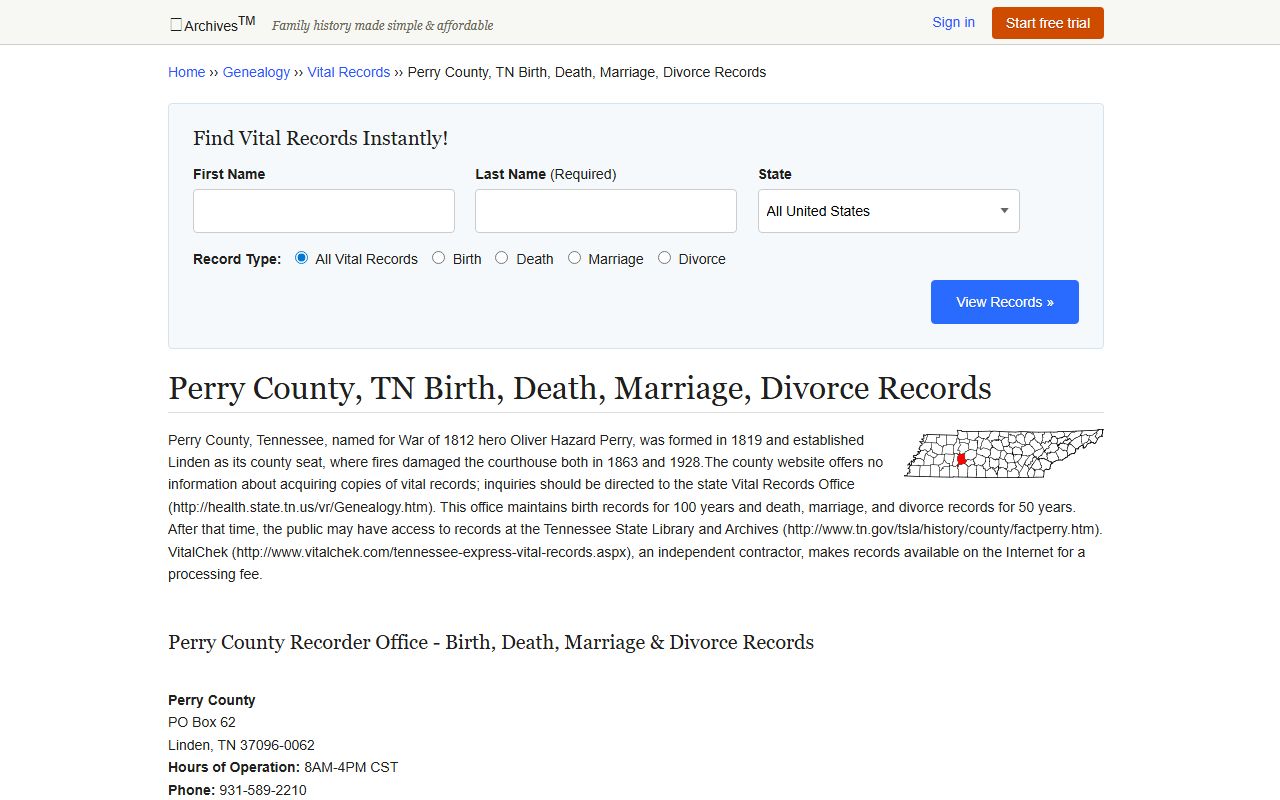
That image is a useful reminder that old Perry County Divorce Records often require a wider search than the courthouse counter alone.
Search Perry County Divorce Records
A good Perry County Divorce Records request should be simple. Give the spouse name, the county, and the rough filing year if you know it. If you have a case number, include it. That helps the clerk find the file quickly, especially if the record is old or if the courthouse copy must be pulled from storage. Perry County's long history means some requests will move faster once the clerk has a narrow window to work with.
State records also matter here. Tennessee Vital Records keeps divorce certificates for the state, and the office says you can request them in person, by mail, or online through VitalChek. That route is best when you need the short state proof of divorce. If you need the full decree, the county court file is still the better paper. The state certificate confirms the event. The county packet carries the court's terms. Knowing the difference helps you avoid a second trip or a wrong order.
For the state request steps, use Tennessee Vital Records.
That page explains how the state certificate side works when Perry County Divorce Records are not enough on their own.
Note: If the divorce is old enough to predate easy courthouse storage, the archive index may save time.
Perry County Divorce Records and Access
Perry County Divorce Records are generally public, but some pages can still be redacted or sealed. Tennessee's public record rules let people ask for records, yet the law still protects private data in a divorce file. That can include child information, financial details, and other pages the court considers sensitive. In a divorce search, public access is common. Full access to every sheet in the file is not automatic. That is why the office and the document type matter so much.
The state entitlement rules also apply when someone wants a certificate from the Office of Vital Records. The state allows the named person, close family members, guardians, and some representatives to request records if they bring the right proof. That helps shape the state side of Perry County Divorce Records, even though the county decree is still the better document for detailed legal work. If you know which office holds the record, the request becomes much more direct.
See the Tennessee Public Records Act exceptions guide for the access limits.
That guide helps explain why a divorce file may be open in part but not in full.
Historical Perry County Divorce Records
Historical Perry County Divorce Records are shaped by the county's courthouse fires and by the way Tennessee moved older records into archive custody. The Perry County historical notes say the county was established in 1819 and that the archives has microfilmed court records available for research. That matters because a fire-damaged courthouse does not mean the divorce record disappeared. It may simply mean the best copy lives in the archive trail instead of on the active courthouse shelf.
That is where the Tennessee State Library and Archives guide helps. It tells researchers that older divorce records move out of the Office of Vital Records after the retention window and into archive custody. The Library of Congress gives the same basic advice. For Perry County, that means a search may begin in Linden, shift to Nashville, and then return to the circuit court if a certified copy of the decree is needed. The record path is rarely a straight line, but the right source usually appears once the age is clear.
Use the Tennessee State Library and Archives guide when the case is historical.
It is the best map for older Perry County Divorce Records that have moved into archive custody.
Order Perry County Divorce Records
If you only need a divorce certificate, the state office can handle the request. Tennessee Vital Records accepts orders in person, by mail, or online through the official VitalChek vendor. That gives Perry County researchers a fast way to confirm the event of the divorce without pulling the full county case file. If you need the decree, however, the circuit court clerk is still the source that matters most. Perry County Divorce Records split naturally into those two tracks.
The split is built into Tennessee law. T.C.A. § 68-3-402 requires court clerks to file divorce records with the Office of Vital Records, which is why the state certificate system exists. That rule helps explain why a Perry County search can turn into both a county request and a state request. A recent case can be found in the county file first and then verified at the state office. An older case may be easier to confirm through the archive path before you order a copy.
For online orders, use VitalChek for Tennessee.
It is useful for the certificate side, not for the full divorce packet.
Note: The county decree is still the better record when a later name change or property issue depends on the court order.
Help With Perry County Divorce Records
Perry County Divorce Records searches usually get easier once you know whether you are chasing the case file, the certificate, or the archive index. The county's historical fire notes make the archive route especially important. If the courthouse cannot find a paper copy right away, the state library and archives may already have a reel or index that points to the right year. That is a normal part of records work in Perry County, and it is one reason local and state sources should be used together.
The Tennessee Secretary of State FAQ and the Library of Congress guide both point researchers back to the same rule. Recent records usually belong with the Office of Vital Records. Older records usually belong with the Tennessee State Library and Archives. That is the simplest way to plan a Perry County Divorce Records search. If you start with the right office, you can usually avoid a long detour and get to the copy or index much faster.
Use the Tennessee divorce records FAQ if you need a quick direction check.
That FAQ is short, but it confirms the state path for older Perry County Divorce Records.
Related Perry County Records
Perry County Divorce Records often connect to marriage records, property history, and the older court indexes that sit beside the decree file. A marriage record can establish the start of the timeline. A deed or tax change can show what happened after the divorce. An index can point you to the right year when the file itself is not at the desk. Those related records help fill the gaps when the case paper is old or partly damaged.
That record chain is worth keeping in mind because Perry County searches often require both county and state material. If one office gives you a reference number, use it to build the next request. If the state gives you a certificate, take that back to the county for the decree. The route is often simple once the right record type is clear.